

An aeration roots blower is a common mechanical component in diffused-air biological treatment systems. It does not treat wastewater itself; it moves a near-constant displaced volume of air per revolution against the resistance created by liquid depth, diffusers, piping and fouling. That air supports oxygen transfer and, where the process requires it, mixing for the microorganisms responsible for removing biodegradable pollutants. Understanding how the blower interacts with basin design, diffuser performance and process control is essential before any procurement decision is made.
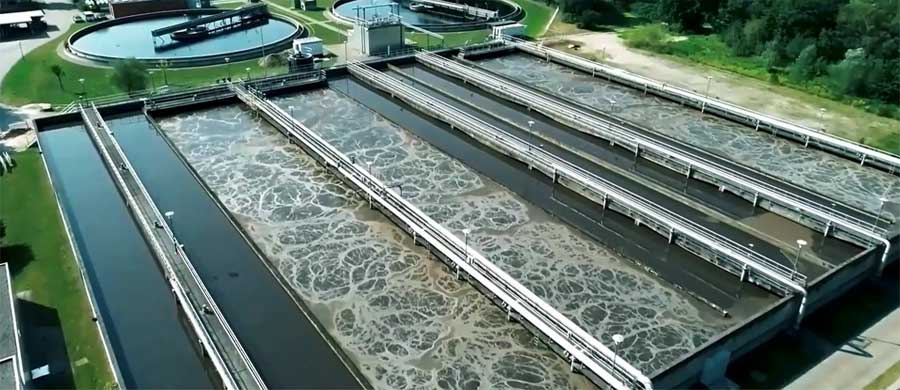
The blower is one component within the aeration system. The process designer establishes oxygen and mixing demand, the diffuser and piping design establish much of the resistance, and the blower supplier verifies the selected machine and package at the declared operating conditions.
This guide brings together the working principle, sizing logic, selection criteria and operating practices that determine whether an aeration roots blower package performs reliably over its design life. The final duty still depends on the process designer’s oxygen and mixing requirements, the diffuser supplier’s data, the connected pressure losses and the site operating conditions.
What Is an Aeration Roots Blower?
An aeration roots blower is a rotary positive-displacement machine built around two synchronized lobed rotors that turn in opposite directions inside a casing with small clearances and no normal rotor-to-case contact. Each revolution traps and carries a defined pocket of air from the inlet to the discharge. The machine does not impose a fixed discharge pressure by itself; pressure and power rise as the connected aeration system resists the displaced air. The actual delivered flow is slightly lower than theoretical displacement because internal slip varies with differential pressure, clearances, gas condition and speed.
This principle has two direct consequences for a wastewater application, provided the blower is selected against the complete system duty:
- The blower supplies near-constant displaced volume at a given speed; the operating point is where the blower performance data and the connected system resistance meet. Water depth, diffuser resistance, piping losses and package losses must therefore be supplied before the machine can be selected.
- The discharge must not be isolated while the blower is running. A positive-displacement machine can raise pressure rapidly against a blocked outlet, so a correctly sized, set and safely discharged relief device, together with non-return protection and a defined isolation sequence, is part of the package. Relief is a safety function, not routine capacity control.
Because the rotors are synchronized by external timing gears rather than by contact, the compression chamber can operate without injected lubricant. Bearings and gears are lubricated separately, outside the process-air path. This is commonly described as “oil-free” or “dry” process-air compression, but the qualification matters: it does not certify the complete delivered air as sterile, food grade or free from all contaminants. Seals, filter bypass, corrosion, pipe cleanliness and maintenance can still affect air quality.
Two Lobe and Three Lobe Aeration Roots Blowers
Two configurations dominate wastewater aeration duties:
- Two-lobe roots blowers use a simple, established rotor geometry and can be attractive where purchase cost, service familiarity and the confirmed duty point support that choice. They still require suitable intake protection and must not be selected on the assumption that particulate ingestion is harmless.
- Three-lobe roots blowers discharge more air pockets per revolution than a two-lobe design and may reduce pulsation at comparable operating conditions. The actual noise and pulsation result still depends on rotor speed, silencer design, piping, support and the connected aeration system.
Neither geometry is universally superior. The correct choice depends on the confirmed airflow and pressure duty points, pulsation and acoustic limits, control range, motor and drive arrangement, maintenance capability, lifecycle cost and the selected package’s performance data. The two-lobe or three-lobe label is not a substitute for a model-specific quotation.
When two models appear to cover the same duty, compare their complete performance and lifecycle basis: absorbed electrical power, sound and pulsation, allowable speed range, maintenance intervals, spares, controls and the effect of fouled diffuser resistance.
Why Aeration Matters in Wastewater Treatment
Across treatment trains that use aerobic biological stages, aeration is the step that supplies oxygen and mixing needed by the microorganisms responsible for removing biodegradable material. In nitrifying systems, oxygen also supports ammonia oxidation. The required aeration duty depends on the biological configuration, load, temperature, oxygen-transfer system and the intended aerobic or anoxic zones; it is not defined by the blower alone.
If oxygen supply falls below process demand, aerobic treatment can deteriorate: nitrification may slow, effluent BOD may rise, sludge settleability may change and odors may develop under some conditions. If aeration is oversupplied, the plant can waste electrical energy without improving effluent quality. The energy consequence depends on blower efficiency, diffuser condition, pressure, control range, motor and drive performance and the process demand over time. An aeration roots blower system therefore has to be sized to a defined operating envelope, not to one average number.
Where Aeration Roots Blowers May Be Used
While activated sludge basins are the most familiar application, an aeration roots blower package may be specified for several distinct duties within a treatment plant. Each one must be checked as its own air service before a common header or shared machine arrangement is proposed:
- Activated sludge and extended-aeration basins, where air supports oxygen transfer and mixing across plug-flow, complete-mix, step-feed or sequencing-batch configurations.
- Aerobic or aerated lagoons, where seasonal temperature, ice cover, loading and nutrient objectives can change the airflow through the year and where other aeration technologies may also be suitable.
- Aerated grit chambers, where air may induce a rolling motion that keeps organics in suspension while denser grit settles; the grit-chamber duty should not be merged with a biological-aeration duty without checking pressure and control compatibility.
- Aerobic digesters, where air can maintain aerobic conditions and mixing for solids stabilization when that process is selected.
- Equalization basins, where air may help prevent septicity and stratification during flow and load averaging.
- Filter backwash and air-scour systems, where a short, high-intensity pulse dislodges solids from granular media; this is normally an intermittent duty with its own sequence and pressure case.
- Pre-aeration or re-aeration where the process design specifically calls for it. It should not be presented generically as a duty ahead of chlorination or another disinfection step.
Each duty has its own airflow, pressure and cycling profile. A single blower room may serve several of them through header branching and zone control, provided simultaneous demand, pressure grouping, air quality, minimum stable flow and distribution are verified rather than assumed. Where the pressure levels or control ranges are incompatible, separate machines or pressure groups may be more efficient and easier to operate.
A common room does not require a common pressure header. Separate pressure groups, staged machines or dedicated packages may reduce throttling when deep biological basins and shallow intermittent users operate at different pressures.
Sizing an Aeration Roots Blower Using Core Variables
A technically sound aeration roots blower selection is built from process data, diffuser performance and system-resistance data, not from basin volume or motor horsepower alone. The selection should return a model-specific performance curve or duty table that covers the minimum, normal and maximum operating cases.
1. Airflow From Oxygen and Mixing Demand
Required airflow is set by at least two checks: the oxygen mass needed for carbon removal and nitrification, converted to field airflow using diffuser transfer data and wastewater, temperature, fouling and site corrections; and the minimum airflow needed to keep the basin mixed and the diffuser grid distributing air within its permitted range. These checks are not automatically added when the same air stream serves both. For each zone and operating sequence, the selected flow must satisfy the controlling demand and its declared flow-reference condition.
For process sizing, express the biological requirement as oxygen transfer rate or actual oxygen transfer rate under stated field conditions, then convert it into airflow using the diffuser supplier’s data and the declared alpha, beta where relevant, temperature, fouling, submergence and site corrections.
2. Differential Pressure at the Worst Credible Case
Discharge pressure is the sum of the static head and dynamic losses in the connected aeration system at the relevant airflow and process state:
- Hydrostatic head at the maximum credible operating water depth or air-release elevation
- Diffuser dynamic wet pressure at the relevant airflow, with clean and aged or fouled conditions stated
- Header, branch, valve, fitting, silencer and inlet-filter losses at the corresponding flow
- Tank gas-space or other process back-pressure where it exists
- Non-return, flexible-connector and package losses included in the supplier’s pressure basis
The blower must be checked at the highest realistic combination of flow and pressure occurring together, not at maximum flow and maximum pressure pulled independently from separate catalogue points. Show each case with its water depth, diffuser condition, process sequence, inlet condition, blower speed, absorbed power and discharge temperature.
3. Site and Inlet Conditions
Ambient temperature, absolute atmospheric pressure, altitude, humidity and inlet-filter condition all change air density. Because oxygen mass transfer, absorbed power and discharge temperature depend on the actual gas and machine conditions, these values must be built into the duty point rather than assumed at a standard 20°C reference. Every quotation should state whether flow is expressed as standard, normal, inlet-referenced or actual volumetric flow, and whether pressure is gauge or absolute. These bases are not interchangeable without conversion.
4. Turndown and Control Strategy
Demand varies by hour, season and, for industrial dischargers, production schedule. Multiple smaller machines, or a single blower on a variable-frequency drive, can track that variation only within the manufacturer’s approved speed, pressure, power, vibration and discharge-temperature envelope. Minimum stable flow, motor cooling and diffuser distribution limits must also be respected. A pressure-relief valve protects the blower; it is a safety device, not a method of routine capacity control, and frequent relief discharge signals a control or system problem that should be investigated.
5. Redundancy and Duty Cycling
Continuous biological treatment may not tolerate an undefined air interruption. Duty/standby, duty/assist/standby and N+1 arrangements are common frameworks, but the correct configuration depends on process criticality, repair time, future expansion, available operator response and how much treatment capacity can realistically be taken offline during maintenance. An oversized single machine is not automatically a reliable one; it may cycle near its minimum speed or be throttled below its efficient range during normal demand.
Energy Considerations for the Complete Aeration System
Positive-displacement rotary-lobe blowers move a near-fixed displaced volume per revolution, but actual delivered airflow changes with differential pressure because of internal slip. Energy should be compared using absorbed electrical power at the same delivered airflow, pressure, inlet condition, flow-reference basis and control range, with motor, drive and package losses included. Generic figures such as a single “watt-hours per cubic metre per metre of head” value should not be published without the original study, system boundary, pressure, flow, reference conditions and technology assumptions. Diffuser type, depth, spacing, air rate, wastewater condition and fouling also affect oxygen transfer and pressure, so lifecycle energy should be evaluated for the complete blower-and-diffuser system rather than from a catalogue label.
For lifecycle comparison, use an annual or load-weighted operating profile rather than one peak point. Include expected seasonal demand, turndown, starts, standby operation, maintenance and the electricity-price or carbon basis relevant to the project.
Installation and Package Interfaces
An aeration roots blower is only as reliable as the package around it. A complete specification should define the following items and their measurement or acceptance basis:
- Inlet filtration and silencing, sized for the site’s dust, particulate and moisture conditions
- Discharge silencing appropriate to the selected rotor geometry, pulsation and acoustic measurement point
- Non-return and pressure-relief valves, correctly rated, positioned, set and safely discharged
- Flexible connectors and supports that manage alignment and limit transmitted vibration
- Instrumentation for airflow, pressure, temperature, speed, power and filter restriction at defined points
- Room ventilation and acoustic treatment sized to the required ambient and sound-pressure limits
- Electrical supply, drive type, starting method, motor cooling and control interfaces matched to the selected machine
- Drainage, condensate management, maintenance access, spare parts and responsibility boundaries
Package pressure losses are part of the duty point. A blower selected only against basin and diffuser resistance, with the package losses added as an afterthought, is not selected correctly. The quotation should show the pressure loss of each material component at the stated airflow and condition.
A comparable RFQ should return the same flow-pressure cases, reference conditions, duty cycle, instrument ranges, package inclusions, exclusions and acceptance checks for every supplier.
Commissioning and Ongoing Operation
Before any process optimization, commissioning should confirm rotation direction, coupling and belt alignment, relief-valve setpoint and discharge path, check-valve orientation, filter condition, ventilation and instrument calibration. At the actual operating water depth and stabilized process condition, record airflow, pressure, inlet condition, discharge temperature, motor or drive load and valve positions at the nearest and most remote branches across the intended control range. This baseline distinguishes a genuine process-load change from a developing leak, obstruction or diffuser-fouling condition.
Trend the commissioned baseline after startup. A slow increase in pressure at the same airflow, a change in branch distribution or a rising discharge temperature can justify inspection before the plant compensates by increasing speed.
Glossary
Aeration roots blower: A rotary positive-displacement machine used to deliver controlled airflow against the variable resistance of a diffused-air wastewater system.
Diffuser: Submerged device that releases air into a liquid as bubbles or another defined gas-release pattern to provide gas-liquid contact and, where designed, oxygen transfer and mixing.
Discharge pressure: Differential pressure the blower must overcome at its outlet, determined by the connected system, gas condition and flow rather than by the blower alone.
Flow reference condition: Declared pressure, temperature, humidity and gas basis used to report airflow, such as actual, inlet-referenced, normal or standard volume.
Operating point: Combination of airflow, differential pressure, inlet condition, speed and absorbed power at which the blower and connected system operate together.
Positive displacement: Operating principle in which a defined gas volume is displaced per revolution, with actual delivered flow affected by pressure, clearances, gas condition and speed within the machine’s rated range.
Slip: Internal leakage or backflow from the higher-pressure side toward the inlet side of a rotary-lobe blower, which reduces actual delivered airflow relative to theoretical displacement and depends on pressure, clearances, gas condition and speed.
Specific oxygen transfer efficiency (SOTE): Percentage of oxygen transferred from the supplied air to clean water under defined standard test conditions. Field wastewater performance requires stated correction factors and operating conditions.
Standard aeration efficiency (SAE): Oxygen-transfer performance normalized by power input under a stated test or field basis; the units and boundary must be declared.
Standard oxygen transfer efficiency (SOTE) correction: Process of converting clean-water test performance into an estimated field value using stated wastewater, temperature, fouling, submergence and site assumptions.
System resistance: Total pressure opposing airflow through the connected package, piping, water depth, valves, fittings and diffusers at a stated flow and condition.
Turndown: Ratio or operating range between a blower’s maximum and minimum stable airflow within its approved speed, pressure, power, temperature and control limits.
Variable-frequency drive (VFD): Motor control device that adjusts blower speed and therefore approximately adjusts delivered airflow, subject to slip, pressure, minimum-speed, motor and process limits.