

Roots blower aeration is widely used in municipal and industrial wastewater treatment plants to supply controlled positive-pressure air to submerged diffuser networks. The blower does not treat the water by itself: the basin, diffuser, biological process, control system and downstream separation determine the treatment result. The blower’s role is to deliver the required air within a defined flow, pressure, temperature, power and control envelope.
Effective Roots blower aeration therefore begins with the process duty, not with motor size or pipe connection. Required airflow, minimum mixing airflow, maximum differential pressure, inlet conditions, turndown, redundancy and diffuser condition should be defined before a model is selected. Oxygen transfer and blower airflow are related but are not the same quantity.
Water Quality and Availability Challenges
Groundwater and surface-water sources are highly vulnerable to contamination from sediment, dissolved minerals, pathogens, nutrients, hydrocarbons and industrial chemicals. For a wastewater treatment plant, the relevant question is not only the condition of the receiving water but also which influent loads and process objectives the plant must control. Source-water or receiving-water context should be connected to the permit, reuse target and treatment basis.
Industrial sites bear an additional layer of responsibility because their effluent characteristics often differ significantly from standard domestic wastewater. Food processing, chemical production, metal finishing and other sectors can introduce variable organic loads, toxicity, salts, metals, solvents or temperature effects. These characteristics must be characterized and controlled before the biological oxygen duty or blower capacity is finalized.
Receiving Water and Catchment Context
Drainage networks and river systems transport pollutants and water from inland catchments to estuaries and coastal zones. Because these systems are connected, inadequate source control, collection or treatment can move a local load downstream. For the treatment designer, this context supports the receiving-water objective; it does not determine the blower duty without influent flow, mass loading and process oxygen requirements.
Municipal and Industrial Wastewater Treatment Stages
A complete treatment train is engineered from the required reuse or discharge standard and the specific influent quality. Preliminary screening and grit removal protect downstream equipment. Primary clarification may remove settleable solids. Secondary biological treatment addresses biodegradable loads and, where designed, nitrogen. Tertiary treatment and disinfection provide additional barriers when the permit or reuse objective requires them. Not every stage needs blower air.
Aerobic biological processes rely on a balance of microbial activity, biodegradable and nitrogenous loading, nutrient availability, temperature, contact time, solids separation and oxygen transfer. A stable dissolved-oxygen reading alone does not prove that the process is meeting its carbon, nitrification or effluent objective. The process designer must define the relevant oxygen-demand and minimum-mixing cases.
Where Roots Blower Aeration Fits In
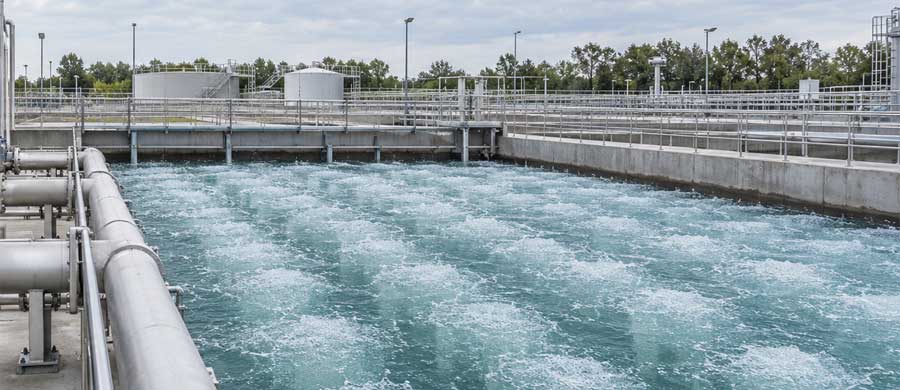
Within a diffused-aeration system, a Roots blower draws ambient air through a dedicated inlet filter and delivers controlled gas flow to headers and submerged diffusers. The diffusers, basin geometry, wastewater characteristics and control strategy determine oxygen-transfer performance. The blower must be selected for the system resistance and the process airflow cases, including diffuser fouling and minimum mixing where applicable.
Because a Roots blower operates as a positive-displacement machine, it moves a defined displacement of gas per revolution and develops pressure against connected-system resistance. It is well suited to duties that require dependable airflow over a defined pressure range, but the selected machine still needs relief, non-return, inlet-filtration, thermal, speed, power and discharge-temperature checks. A relief valve is a safety device, not a substitute for capacity control.
7 Critical Design Factors for Roots Blower Aeration
A reliable Roots blower aeration design starts with a defined duty point and the complete resistance of the air-delivery system. The following factors should be stated in every technical enquiry, together with normal, minimum, peak and out-of-service cases. The process designer owns the oxygen and mixing basis; the blower supplier checks whether the air package can operate inside its approved envelope.
- Process oxygen and mixing demand. Establish the oxygen uptake or oxygen-transfer requirement for carbon removal, nitrification and other aerobic duties. Convert the process requirement to the required air envelope using declared wastewater, temperature, pressure, elevation and diffuser-performance assumptions, and check minimum airflow for mixing independently.
- Required airflow and reference conditions. State whether flow is at the blower inlet, standard conditions, normal conditions or another defined basis. Compare Roots blower aeration capacities only after temperature, pressure, humidity and density references are aligned.
- Maximum differential pressure. Include maximum operating water depth, diffuser dynamic wet pressure, pipe and valve losses, non-return-valve resistance, package losses and a justified fouling or uncertainty allowance. Select against the maximum credible duty, not only average pressure.
- Site and inlet conditions. Include ambient temperature, atmospheric pressure, altitude, humidity, inlet-filter condition and air quality because they affect density, mass flow, absorbed power and discharge temperature.
- Turndown and control philosophy. Define minimum, normal and peak airflow, the required control range and the relationship between dissolved-oxygen control, airflow measurement and blower speed. A VFD must remain within the approved speed, power, temperature and pressure envelope.
- Redundancy and operating sequence. Determine duty and standby machines from process criticality, maintenance requirements and the full load profile. The sequence should distribute operating hours while keeping each blower within its permissible range and protecting unavailable trains.
- Package and installation interfaces. Specify inlet filtration and silencing, discharge silencing, check and relief valves, flexible connections, instruments, acoustic requirements, room ventilation, electrical supply and maintenance access. Include package pressure losses in the final duty point.
For each Roots blower aeration project, Pasifik Blower evaluates the required inlet flow, differential pressure, blower speed, absorbed power and discharge temperature against the application data. The quotation should state the reference condition, clean and fouled pressure cases, selected operating range, motor basis, included accessories, control interface and the assumptions that remain with the process or diffuser supplier.
Roots Blower Aeration: Frequently Asked Questions
What is Roots blower aeration?
Roots blower aeration uses a rotary positive-displacement blower to deliver a predictable air volume to submerged diffusers. The diffusers create bubbles and gas-liquid contact, but oxygen-transfer performance depends on diffuser type and condition, basin depth, wastewater characteristics, temperature, pressure and control. The blower supplies air; it does not by itself guarantee oxygen transfer or biological treatment.
How is the required aeration pressure determined?
Required differential pressure is the sum of hydrostatic head at the maximum relevant water depth, diffuser dynamic wet pressure, piping and valve losses, non-return and package losses, and a justified fouling or uncertainty allowance. The calculation must use the same airflow reference and operating case as the blower selection.
Can Roots blower aeration be controlled with a VFD?
Yes. A variable-frequency drive can adjust blower speed and airflow when the selected machine remains within its permitted minimum and maximum speed, pressure, power and discharge-temperature limits. The process-control system still needs valid airflow and dissolved-oxygen measurements, stable air distribution and a safe response to sensor failure. A VFD does not remove the need for relief and non-return protection.
What information is required for Roots blower aeration selection?
A complete Roots blower aeration enquiry should state the application, process oxygen and minimum-mixing basis, required inlet airflow and reference conditions, maximum differential pressure, clean and fouled diffuser cases, inlet temperature and pressure, altitude, turndown, duty cycle, standby philosophy, motor supply, control interface, noise limit, package components and site responsibility split.
Glossary
Aeration basin: A reactor in which wastewater and biological solids are mixed while air or oxygen is supplied for a defined biological and mixing objective.
Alpha factor: Ratio used to express oxygen-transfer behavior in wastewater relative to clean water under defined test and operating conditions.
Aerobic biological treatment: Treatment that uses oxygen-dependent microorganisms to convert biodegradable constituents into new biomass, oxidized products and other stable forms under stated process conditions.
Backpressure: Differential pressure developed by liquid depth, diffusers, valves, piping and other connected-system resistance against the blower discharge.
Biochemical oxygen demand (BOD): An empirical measure of oxygen consumed by microorganisms under a specified test method and time period; BOD5, CBOD5 and other bases should not be treated as interchangeable without definition.
Diffused aeration: Introducing pressurized air through submerged diffusers to create gas-liquid contact for oxygen transfer and, where required, mixing.
Diffuser fouling: Accumulation or deterioration that changes diffuser resistance, bubble distribution and oxygen-transfer performance over time.
Effluent: Water leaving a facility or defined treatment stage; the sampling point and applicable quality basis must be stated.
Oxygen transfer: Movement of oxygen from the supplied gas phase into the liquid; the achieved rate depends on diffuser performance, wastewater conditions, basin hydraulics and operating state, not blower flow alone.
Oxygen uptake rate (OUR): Rate at which the biological process consumes oxygen under a stated operating condition; OUR is a process demand, not a blower airflow rating.
Positive-displacement blower: A machine that moves a defined gas displacement per revolution and develops pressure against system resistance; operating limits, relief, non-return and minimum-speed requirements remain part of the package design.
Receiving water: The river, stream, lake, estuary, coastal water, groundwater or other water body that receives a discharge under the applicable permit or reuse context.
Water resource protection: Measures that preserve water quality and availability through source control, collection, treatment, monitoring, reuse and responsible discharge management.