

In food plants, roots blowers for thermal processing may supply process air or transfer ingredients when the required duty fits the machine’s operating range. Pasteurization and commercial sterilization are important examples, but they represent only part of the thermal-processing landscape. Industrial food plants also employ evaporation, fluidized-bed drying, vacuum drying, spray-dryer air handling, product cooling and temperature-controlled pneumatic conveying.
A roots blower can contribute to some of these operations, but it should not be described as a universal thermal-processing machine. It does not generate process heat in the same way as a steam boiler, burner or electric heater, nor is it automatically the correct air mover for every dryer, oven, retort or cooling tunnel. Its legitimate role is to move a predictable volume of air, vapor or process gas when the required flow rate, differential pressure, temperature, gas composition and cleanliness conditions fall within the operating capabilities of rotary-lobe technology.
The distinction is important. In correctly engineered installations, a roots blower may support heat and mass transfer, maintain fluidization, transport ingredients to and from thermal equipment, increase vacuum-system pumping speed or recompress process vapor in an evaporation system. In other installations, an axial or centrifugal fan, screw blower, liquid-ring pump, vacuum pump or centrifugal vapor compressor will be more appropriate.
How a Roots Blower Interacts with a Thermal Process
A roots blower is a positive-displacement gas-moving machine. Two synchronized lobed rotors rotate in opposite directions, trapping discrete volumes of gas between the rotors and casing and transferring them from the inlet to the discharge side. The rotors do not normally contact each other or the compression chamber, ensuring 100% oil-free air delivery which is strictly required for food processing and product contact.
The machine delivers an approximately fixed inlet volume per revolution. Actual delivered flow is affected by rotational speed, inlet density, internal leakage, pressure ratio, temperature and mechanical clearances. The blower does not establish the operating pressure independently. Discharge pressure develops in response to resistance created by the complete system, including:
- Air filters
- Heat exchangers and air heaters
- Distribution plates
- Fluidized material beds
- Ductwork and pipelines
- Bends and control dampers
- Cyclones and separators
- Bag filters
- Product receivers
- Silencers and non-return valves
Consequently, a roots blower used around thermal-processing equipment must be selected against the maximum realistic system resistance, not merely the nominal pressure measured during clean and stable operation.
Because the machine performs work on the gas, the discharge temperature rises as differential pressure increases. This temperature rise must be included in process calculations. In some installations it contributes a small amount of useful sensible heat. Nevertheless, blower compression heat should not be treated as the primary or precisely controllable heating source unless the entire system has been specifically designed around heat recovery.
Process Air for Fluidized-Bed Drying
Fluidized-bed drying is one of the thermal operations in which a roots blower may have a technically defensible role. Heated air passes upward through a perforated distributor and a bed of particles. When the upward aerodynamic force becomes sufficient to balance the effective weight of the particles, the bed expands and behaves like a fluid.
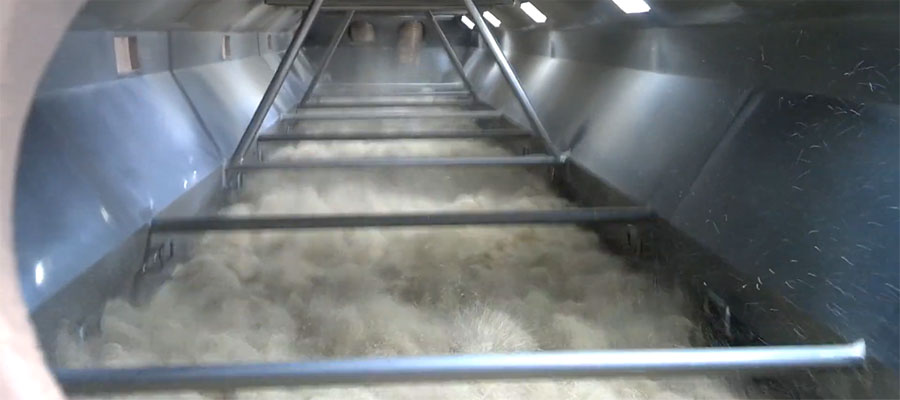
Fluidization increases contact between the process air and particle surfaces. This can produce rapid heat transfer, efficient moisture removal and relatively uniform product treatment. Fluidized-bed systems are used for products such as food powders, granules, crystals, starch derivatives, yeast, sugar, salt, seeds and selected agglomerated ingredients.
A roots blower may be considered when the process requires:
- A relatively stable airflow despite variations in bed resistance
- Moderate positive pressure
- Continuous operation
- Airflow through a distributor plate with a significant pressure drop
- Controlled response to changing product loading
- Sufficient pressure capacity to overcome downstream filtration resistance
The blower is not automatically the preferred choice. Many fluidized-bed dryers use centrifugal fans because the required flow is high while the differential pressure remains relatively low. Roots technology becomes more relevant when the pressure requirement is above the efficient operating range of a conventional process fan or when changes in system resistance would otherwise cause unacceptable variations in airflow.
The superficial air velocity must remain above the minimum fluidization velocity but below the level at which excessive entrainment, attrition or particle carryover occurs. There is no universal velocity suitable for all food materials. Particle size, shape, density, moisture content, cohesiveness and size distribution influence the fluidization behavior.
Fine, cohesive or moist powders may channel, form agglomerates or move as unstable plugs instead of fluidizing uniformly. Very light particles can be carried out of the bed, while fragile granules may degrade under excessive gas velocity or prolonged particle-to-particle impact. Blower selection must therefore follow material testing and fluidization analysis rather than a general airflow rule.
Determining the Required Drying-Air Flow
The required mass flow of process air is related to both the thermal load and the amount of moisture that must be removed. A simplified sensible-heat relationship can be written as:
Sensible Heat Relationship
- Qthermal = thermal duty, W
- ṁair = dry-air mass flow rate, kg/s
- cp,air = specific heat capacity of air, J/(kg·K)
- Tsupply = supply-air temperature, °C or K
- Texhaust = exhaust-air temperature, °C or K
This equation alone is insufficient for designing a dryer because evaporation also requires latent heat. A complete heat and mass balance must include:
- Initial and final product moisture
- Product feed rate
- Moisture evaporation rate
- Latent heat of vaporization
- Product heating
- Equipment heat losses
- Inlet-air humidity
- Exhaust-air humidity
- Air recirculation ratio
- Leakage and infiltration
- Heat recovered from exhaust air
- Heat added by the blower
Once the required air mass flow has been established, the corresponding inlet volumetric flow is:
Inlet Volumetric Flow
- Vin = inlet volumetric flow
- ṁair = dry-air mass flow rate
- ρin = gas density at actual blower inlet conditions
This distinction is essential. A blower handles volume at its inlet conditions, whereas the process engineer may specify airflow at heater outlet, dryer inlet, standard conditions or normal conditions. These values are not interchangeable (e.g., Nm³/h vs. Sm³/h vs. actual m³/h, or SCFM vs. ACFM).
As air is heated, its density decreases and its actual volumetric flow increases. Therefore:
Actual Volumetric Flow
A specification that fails to state the reference temperature and pressure can result in an undersized or oversized blower, heater, distributor and duct system.
Equipment Scope and Selection Limits
A roots blower can contribute process airflow, but it does not provide process heat. Check required flow, system resistance, discharge temperature, product contact, site altitude, and operating range for the actual process.
Glossary
ACFM / SCFM: Actual Cubic Feet per Minute and Standard Cubic Feet per Minute, commonly used in imperial system specifications.
Actual volumetric flow: Gas volume per unit time at the real inlet pressure and temperature.
Condensate: Liquid formed when process vapor cools below its dew point.
Differential pressure: Absolute discharge pressure minus absolute inlet pressure.
Duty point: Specified flow, pressure, temperature and gas condition for equipment selection.
MVR: Mechanical vapor recompression used to recover latent heat from secondary vapor.
Nm³/h (Normal cubic meters per hour): Volumetric flow rate evaluated at normal reference conditions (typically 0°C and 1.013 bar absolute).
Pressure ratio: Absolute discharge pressure divided by absolute inlet pressure.
Sm³/h (Standard cubic meters per hour): Volumetric flow rate evaluated at standard reference conditions (frequently 20°C and 1.013 bar absolute).
Thermal load: Rate of heat addition or removal required by the process.
Vapor compressor: Purpose-designed machine for compressing process vapor rather than ambient air.