

Roots blowers for chemical industry applications can support selected gas-transfer, process-air and solids-conveying duties when the medium, flow and pressure fit the machine’s approved operating range. Chemical plants handle reactive gases, corrosive vapours, solvents, powders and granules, each with distinct equipment and safety requirements. A standard air-blower rating does not establish suitability for these services.
For detailed technical articles, click here.
A roots blower transfers gas through synchronized lobed rotors. Its swept volume per revolution is approximately fixed, but actual delivery varies with speed, inlet conditions, differential pressure and internal slip. The connected system determines the operating pressure. The blower, seals, materials and package therefore need assessment against the complete process duty.
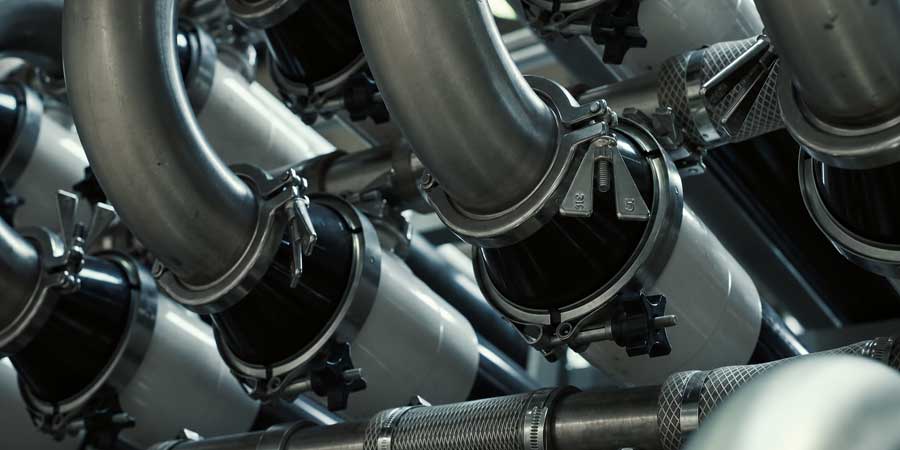
How a Roots Blower Fits Chemical Processes
Roots blowers are considered for applications that need a defined flow against a low or moderate pressure rise. Their role may be to move or recirculate process gas, boost a gas stream, supply air to a process or provide conveying air. The machine does not remove contaminants, change gas composition or guarantee a specified product quality.
In external compression, the blower transfers gas from inlet to discharge without substantial compression inside the rotor chamber. Pressure develops as the gas meets downstream system resistance. This operating principle makes the full pressure-loss calculation important: a restriction in a filter, valve or pipeline can increase the pressure the blower must overcome, absorbed power and discharge temperature.
The blower’s process connection also varies by application. For positive-pressure conveying, the air source supplies the line and solids enter downstream through a suitable feeder. For gas boosting, the process gas itself passes through the machine, so composition, moisture, temperature and leakage control become central to selection. These arrangements should not be treated as interchangeable.
Application Areas and Process Boundaries
Chemical powders and granules. A positive-pressure system can move dry powders, pellets or granules between storage, processing and packaging stages. The blower supplies clean conveying gas; a feeder introduces the solid downstream, and a receiver separates it from the gas at the destination. Feeder leakage, line geometry, bend wear, product degradation and receiver-filter resistance all affect the duty.
The conveyed material may be toxic, abrasive, hygroscopic or combustible. Its properties determine feeder design, pipe materials, filtration and required process safeguards. The solids should remain out of the blower’s gas path unless the machine is specifically designed for that exposure. A dust hazard assessment is also needed where the material can form an ignitable cloud.
Process-gas transfer and boosting. Chemical and petrochemical plants may need to move gas through reactors, scrubbers, heat exchangers, adsorbers, filters, recovery equipment or distribution headers. A purpose-designed process-gas blower may fit when it can handle the composition and operating range while meeting the required flow and pressure. The evaluation should use a representative gas analysis, including trace compounds that could affect corrosion, deposits, seals or downstream product.
Flow changes during start-up, shutdown, purging, cleaning or process upsets can differ from steady operation. These cases should be included in the duty definition. If a process stream contains recoverable solvents or hydrocarbons, the blower may form one part of a larger recovery train; separation, cooling or condensation equipment may be required around it.
Flare and vent-gas recovery. Selected low-pressure gas streams may be routed to fuel service, treatment or process reuse. A Roots blower can be considered only when its pressure rise, capacity and gas compatibility suit the recovery case. Variable flow, changing composition, condensable vapours and liquid carryover need specific review.
The recovery package must preserve the function of the plant’s flare and relief systems. It needs a safe disposition path for gas that cannot be recovered or exceeds the recovery equipment’s capacity. A knock-out vessel may be needed to remove liquid before the gas reaches the machine. Recovery equipment also needs pressure control and containment provisions appropriate to the process. A DOE/NETL process diagram, for example, shows flare-gas recovery with liquid separation and routing to a fuel-gas header; that example does not establish suitability of a Roots blower for a separate project.
Fluidized-bed gas supply. Gas passing upward through a distributor can mobilize particles in a bed used for drying, cooling, coating, granulation or reaction. A Roots blower may fit when the required flow and pressure align with its performance range. The calculation includes losses through the distributor, bed, piping, valves and downstream filtration.
The minimum fluidization velocity is the superficial gas velocity at which the bed begins to expand under upward flow. It depends on particle size, density, shape, moisture, cohesion and gas properties, so it should be established from material-specific data or an appropriate test. Excess airflow can entrain solids, increase erosion and overload filters. For a very high-volume, low-pressure duty, a fan may be the more suitable machine class.
Product-sensitive gas service. Some chemical processes limit oil, particles, moisture or other contaminants in gas at a product-contact point. In a conventional Roots design, lubricant is not intentionally injected into the rotor chamber; bearings and timing gears are lubricated separately. This describes the machine’s compression arrangement and does not certify the complete gas supply as contaminant-free. Intake filters, dryers, silencers, piping residue, condensate and maintenance practices can all affect delivered-gas quality.
Gas Compatibility, Containment and Blower Duty
The gas containment requirement should state the acceptable leakage level and how leakage will be monitored or managed. It may involve casing and rotor materials, coatings, elastomers, shaft seals, purge connections, venting and the destination for collected leakage. Suitability depends on the gas composition, temperature, pressure and the project’s safety requirements.
On a suction-side system, leakage can draw air into the process stream and alter its composition. On a positive-pressure connection, process gas can escape into the surrounding area. Corrosive components may also behave differently when moisture or condensate is present. The project should define expected gas composition during normal operation and credible transients before the supplier selects materials and seals.
Electrical and control equipment should match the site’s hazardous-area classification where one applies. That classification and the equipment requirements are site-specific; they cannot be inferred from the blower model alone. OSHA’s requirements for classified locations address electrical equipment and wiring, while the equipment and installation still require review against the applicable project rules.
Flow and pressure data must use clear reference conditions. Actual inlet volume flow is the gas volume at the blower’s inlet pressure, temperature and composition. When the process requirement is stated at normal or standard conditions, it must be converted before comparison with blower performance data at actual inlet conditions:
Volumetric Flow Correction (with Compressibility Factor)
Pressures and temperatures in this relation are absolute. The reference conditions for “normal” or “standard” volume must be stated, and the compressibility factor, \(Z\), should correspond to the gas and conditions being evaluated.
Calculate flange differential pressure from the blower inlet- and outlet-flange pressures:
Blower Pressure Difference
The flange pressures should reflect losses on both sides of the machine, including filters, adsorbers, scrubbers, valves, piping and the destination process. For pressure ratio, use absolute values:
Absolute Pressure Ratio
Review minimum, normal and maximum flow and pressure cases, along with inlet temperature, speed, absorbed power and discharge temperature. A single nominal point can miss a limiting start-up or turndown condition. Any restriction that pushes the machine beyond its approved envelope needs a process or equipment review; increasing speed is not a substitute for confirming the cause.
Preparing a Technical Review
A useful enquiry describes each service separately, even if the plant expects one package to serve several duties. Include:
- Gas composition, trace contaminants and expected variation.
- Required flow, reference conditions, inlet and discharge pressure, and temperature.
- Pressure-loss breakdown through the process and connected equipment.
- Moisture, condensable vapours, liquid carryover, particulates and corrosive exposure.
- Required leakage control, sealing or purge arrangement, vent destination and area classification.
- Normal, minimum, maximum, start-up, shutdown, purge and cleaning cases.
- For powder conveying, material properties, feeder, pipeline route and receiver-filter duty.
- For a fluidized bed, particle data, bed depth, distributor resistance and filtration.
- For recovery service, header pressure range, recoverable flow cases and the relief-system interface.
- Site conditions, operating hours, turndown, control philosophy and redundancy needs.
Pasifik Blower can assess a proposed positive-pressure duty against model-specific performance data. The review should confirm the flow, differential pressure, speed, motor power, temperature and package limits for the stated gas or air service. Special gas compatibility, containment and vacuum duties require separate confirmation; they should not be inferred from a standard air curve.
Glossary
Actual inlet volume flow: Gas volume evaluated at the blower’s inlet pressure, temperature and composition. It can be compared directly only with performance data using the same inlet basis.
External compression: Compression process in which pressure develops as gas discharged from the blower meets resistance in the connected system. The blower transfers gas through its rotor chamber without substantial internal compression.
Flange differential pressure: Difference between pressure at the blower discharge flange and pressure at its suction flange. It is checked with flow and other operating limits to confirm the machine duty.
Flare-gas recovery: Collection and redirection of gas that would otherwise be sent to a flare. Recovery equipment needs a defined operating range and must remain integrated with the plant’s relief arrangements.
Gas containment: Design measures used to control and manage process-gas leakage from equipment and connections. Requirements depend on the gas, pressure, temperature and project safety basis.
Hazardous-area classification: Site designation for areas where flammable gas, vapour or dust may be present under defined conditions. It informs the selection of electrical and control equipment for that location.
Minimum fluidization velocity: Superficial gas velocity at which upward flow begins to expand a bed of particles. Its value depends on the material and operating conditions.