

Receiver filters for positive-pressure roots blower conveying: the evaluation begins with defined process conditions, material data and equipment boundaries. At the end of a positive-pressure pneumatic conveying line, the receiver must separate transported solids while allowing conveying air to leave safely. The filter is therefore both a product-recovery component and a major source of system resistance. If it is undersized, poorly cleaned or incorrectly vented, receiver pressure rises and the roots blower sees a higher differential pressure.
Filter selection should begin with actual gas volume and dust properties at the receiver—not only with the blower’s nominal free-air delivery.
Surface and Depth Filtration
Many receiver filters operate mainly by surface filtration. Particles accumulate on or near the media surface and form a dust cake that contributes to collection. Other media rely more heavily on particles entering a fibrous or porous depth. The practical behavior depends on media construction, particle size and cleaning method.
The filter supplier should evaluate:
- Particle-size distribution and dust concentration.
- Bulk and true particle density.
- Abrasiveness, cohesiveness and electrostatic behavior.
- Gas temperature and moisture content.
- Chemical compatibility and product-hygiene requirements.
- Required outlet concentration or recovery target.
- Normal and surge airflow.
Very fine media are not automatically the best choice. Excess resistance can raise receiver pressure, power and cleaning frequency. The objective is verified separation with a stable pressure-drop range.
Filter Area and Actual Receiver Airflow
Filter area is commonly related to the actual gas volume passing through the media and the selected filtration velocity:
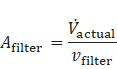
The permissible filtration velocity must come from the filter supplier for the product, media and cleaning system. Actual receiver flow may differ from a catalogue or reference volume because gas pressure and temperature change through the conveying circuit.
Peak flow matters. Purging, simultaneous feeders, leakage and route changes can briefly send more air to the receiver than the normal conveying condition. The vent and filter must accept those conditions without exceeding the vessel’s permitted pressure.
Clean and Fouled Pressure Drop
A new filter element has a clean resistance. During service, dust cake and embedded particles increase that resistance until the cleaning system restores part of the available area. Blower selection should therefore use a realistic maximum normal differential pressure, not only the clean value.
Pressure measurement across the filter provides direct operational information. A rising trend may indicate inadequate cleaning, blinded media, moisture, excessive dust load or a failed cleaning valve. An unexpectedly low differential pressure can indicate torn media, an open bypass or instrumentation failure.
Cleaning Method and Separate Utilities
Mechanical shaking, reverse flow and pulse cleaning each impose different operating conditions. Pulse-jet cleaning uses brief air pulses delivered through dedicated valves and headers. Its air quality, storage and pressure requirements should be defined independently; a low-pressure conveying roots blower should not be assumed to provide a high-pressure cleaning pulse.
Cleaning frequency should respond to validated pressure-drop or cycle logic. Excessive cleaning can consume utility air and mechanically stress media, while insufficient cleaning reduces receiver capacity.
Product Discharge, Safety and Maintenance
Collected material must discharge without uncontrolled gas leakage. The receiver airlock, level control and downstream equipment must be sized for both product rate and pressure difference. A full receiver or stalled discharge device can load the filter rapidly.
Combustible dust requires a site-specific hazard assessment covering containment, grounding, isolation, venting or suppression, safe access and the consequences of a filter failure. Filter selection alone does not resolve the hazard.
Maintenance access should allow inspection and replacement without dropping foreign material into the receiver. The design should also prevent condensate from wetting dust cake and creating permanent blinding.
Connecting Filter Data to Pasifik Blower Duty
The roots blower duty must include the maximum expected receiver pressure, filter resistance and clean-air discharge losses. As resistance rises, a positive-displacement blower can continue moving substantial volume within its operating range, which raises absorbed power and discharge temperature rather than safely self-limiting the flow.
Glossary
Air-to-cloth ratio: Actual gas volume per unit of effective fabric area, equivalent to average filtration velocity.
Dust cake: Layer of collected particulate formed on filter media during operation.
Filter blinding: Persistent blockage of media pores that cleaning does not adequately reverse.
Filtration velocity: Average actual gas velocity through the effective filter area.
Pulse cleaning: Short controlled air pulse used to detach accumulated dust from filter elements.
Receiver vent capacity: Maximum gas flow a receiver separation system can discharge within its permitted pressure.